







These days, nearly every business needs good writing. Websites, blogs, and social media pages all run on words. And here is the good news: they are happy to pay for quality content. So if you want to learn how to make money as a freelance writer, you have come to the right place.
This guide will show you simple, real-world ways to start earning. You will discover smart income ideas that work for beginners. No experience? No problem. Just follow the steps, avoid a few common mistakes, and grow at your own pace.
How to Make Money as a Freelance Writer With 5 Steps
1. Pick a Small Niche That Matches Your Real Interests
Don't try to write about everything. Beginners often waste time by pitching random topics. Instead, choose one specific area you already know something about — like gardening, small business tips, or video game reviews.
This makes your writing feel real and helps you sound like an expert faster. For example, if you've worked at a coffee shop, pitch articles about running a café or barista skills. Clients notice when you understand their world.
2. Create a Simple Portfolio Without Any Paid Work Yet
You don't need paid clips to get started. Write 2–3 short samples (300 words each) on your chosen niche. Post them on a free Google Doc or a simple Canva site.
Make sure each sample solves a problem — like "How to Save Money on Coffee Beans" or "Three Easy Ways to Water Plants While on Vacation."
Never send a client a link to an empty portfolio. Having real examples, even unpaid ones, proves you can write clearly and helps you skip the "no experience" trap.
3. Find Your First Clients on Low-Pressure Platforms
Skip big freelance marketplaces like Upwork at first — they're crowded. Instead, try smaller job boards like ProBlogger or Freelance Writing Jobs.
Another smart move: search Twitter or LinkedIn for "guest post" plus your niche. Many blog owners openly ask for writers. When you find a post, send a short, friendly pitch (2–3 sentences).
Example: "I see you accept guest posts. I can write '5 Ways to Reduce Food Waste at Home' for $40. Would that work for you?" Keep it simple and direct.
4. Set Your First Rate and Learn to Say "No" Gracefully
Many beginners charge $0.03–$0.05 per word, which is fine for starting. For a 500-word post, that's $15–$25.
But never agree to work for "exposure" or vague promises — you'll burn out fast. If a client offers less than $10 per article, politely decline.
Say: "Thanks for the offer, but my rate starts at $15 per post. Let me know if that works for you." You'll feel awkward at first, but setting a clear price teaches clients to respect your time.
5. Deliver Early and Ask for a Testimonial or Referral
The easiest way to earn more money is to keep past clients happy. Finish every project one day before the deadline and include a short note like "I hope this works! Happy to make changes."
After they pay, ask: "Would you mind writing 1–2 sentences about working with me? I'd love to use it for future clients."
Then ask for a referral: "Do you know anyone else who needs a writer?" That one question often leads to your next paid gig without any cold pitching.
Common Mistakes as a New Freelance Writer
Starting out is exciting, but many beginners trip over the same few traps. Here's how to avoid them:
- Charging way too little (or working for free). Some new writers take $5 articles just to get clips. That trains clients to expect cheap work. Instead, start at $0.03–$0.05 per word. You'll attract better clients right away.
- Skipping a simple contract. Even a short email agreeing on deadline, price, and revisions helps. Without it, clients may ask for endless changes or pay late. A quick "Here's what we agreed on" message protects you.
- Missing deadlines by even one day. Freelance writing runs on trust. Turn in work early or on time, every time. If you're late once, that client probably won't hire you again. Set a personal deadline two days before the real one.
- Trying to write about everything. Generalists struggle to stand out. Pick one small niche (pet care, small business, cooking). You'll get hired faster when clients see you as the "go-to" person for their topic.
- Not asking for testimonials. After a happy client pays, ask for 1–2 sentences about your work. Those quotes get you your next gig. Most beginners forget this simple step.
Why Some Writers Struggle to Find Clients
Many freelance writers struggle to find clients not because they lack writing skill. Instead, the main problem is often their marketing ability. A writer can be very good, but if they are bad at reaching out to potential clients, it will be hard for them to get work.
Having something that makes them different from other writers, like expertise in a specific topic, also matters. Using the wrong ways to find clients is another issue.
Some writers use channels like Upwork, while others succeed with methods like inbound marketing through an SEO-friendly portfolio website.
6 Best Sites That Pay Freelance Writers Good Rates
Medium – Best for Complete Beginners Who Want to Write About Anything
Medium is a large online publishing platform where anyone can start writing and earning money for free. You don't need to pitch editors or wait for approval — just sign up, write a post, and publish it.
The Medium Partner Program pays you based on how many minutes paying members spend reading your articles. Experienced writers on Medium often earn around $10 to $20 for every 1,000 internal member reads on their stories.
This makes it a great starting point because you can build a portfolio while earning something at the same time. The key is to write consistently, at least once or twice per week, so you grow a small group of regular readers.
Contently – Best for Experienced Writers Looking for Premium Rates

Contently is a selective platform that connects freelance writers with well-known brands. You need a portfolio with at least 10 writing samples from 3 different clients just to apply. The pay is worth the effort — rates typically range from $0.05 to $0.10 per word, with some projects paying much higher.
For example, a 500–700 word article starts at $300, and longer reported pieces can reach $1,250 or more. If you already have some paid writing experience, this is a great next step after building up a few clients on easier platforms.
WriterAccess – Best for Writers Who Want Clear, Predictable Pay Tiers

WriterAccess uses a simple 6-star rating system. Writers start at 2 stars earning 2 cents per word, and as you get good reviews, you can move up to 6 stars earning anywhere from 10 cents to $2 per word.
Freelancers keep 70% of what clients pay for each order, and the platform charges a 30% fee. One smart strategy is to start with lower-star orders to build up your ratings quickly, then raise your rates once you reach 4 stars or higher. This approach helps you move from smaller pay to much larger projects over time.
ClearVoice – Best for Writers Ready to Work With Professional Marketing Teams

ClearVoice is a content marketplace where brands and agencies find vetted freelance writers. The platform hosts writers at all skill levels — newer writers typically charge $100–$300 per article, while experienced professionals can earn $1,000 or more for a single piece.
ClearVoice takes a 25% fee from freelancers on each assignment, so keep that in mind when setting your rates.
You must apply and be accepted into their talent network, so having a strong portfolio with at least 5–8 solid writing samples is essential before you apply.
nDash – Best for Writers Who Want to Set Their Own Rates and Pitch Brands
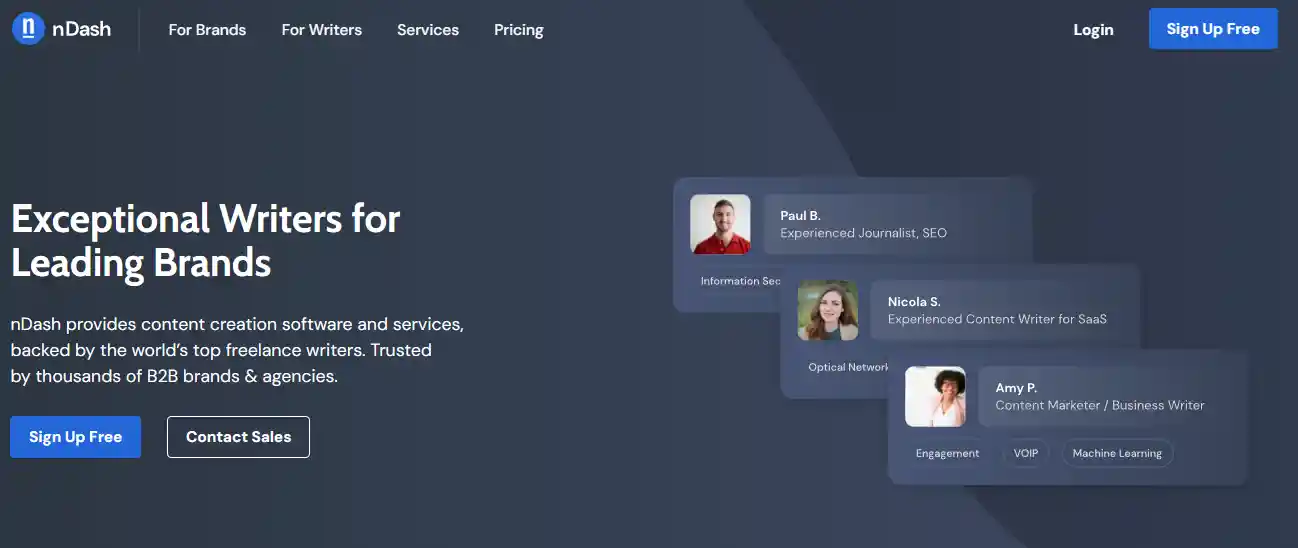
nDash is built for B2B writing — think blog posts, whitepapers, and other long-form content for companies. Unlike many sites, nDash lets you decide your own rates and reach out to brands directly. Most jobs fall between $150 and $450, and believe it or not, some writers here make six figures a year.
Just know that nDash is selective. Only a small percentage of writers get full approval. So do not rush. Spend real time making your profile detailed and impressive. Show off your very best samples.
Why? Because most projects are sent privately. A strong profile means clients find you first. Put in the effort, and nDash can pay off big time.
iWriter – Best for Building Up Writing Speed and Getting Quick Feedback

iWriter is a straightforward platform where webmasters post article requests and writers claim them. Writers start at the "Standard" level, then move up to "Premium" and "Elite" based on their ratings. An Elite Plus writer can earn $55.50 for a 1,000-word article.
The platform pays freelancers 81% of the earnings from each client. The biggest advantage of iWriter is the sheer volume of available work — you can grab as many assignments as you want. This is perfect for practicing different writing styles and improving your speed, even if the per-word pay starts lower.
How Freelance Writers Can Stand Out in the AI Era
Stop Selling "Writing" — Sell a Specific Outcome
Saying "I am a blog writer" is too generic in the AI era. Clients can get generic writing from AI for free. Instead, offer something like lead generation, SaaS onboarding help, or building authority for a business.
When you promise a real business result instead of just words, clients are happy to pay more.
Pick One Type of Client You Understand Deeply
Generalist writers are the easiest to replace because they know a little about many topics. Pick one niche based on real industry knowledge, not just passion.
Learn one audience's pain points and the way they talk. Becoming fluent in that world makes a writer hard to copy, even by the smartest AI.
Use Information AI Cannot Access
AI can only use public information from the internet. It cannot interview real people. A freelance writer can talk to founders, customers, or experts and turn those conversations into unique insights.
Building content from first-hand data instead of recycled online facts gives writing a huge edge.
Write From Perspective, Not Just Information
AI is great at summarizing facts, but it rarely creates strong opinions. A human writer adds interpretation, experience, and good judgment.
Use "why this matters" analysis to increase value. Readers trust a real point of view, not a robot that stays neutral on everything.
Build Proof That You Drive Results
Do not just show a portfolio full of samples. Replace them with short case studies. Show how your writing brought traffic, leads, search rankings, or actual sales.
Explain the strategy behind the content. Numbers and results impress clients much more than a nice paragraph about your hobby.
Use AI as an Assistant, Not a Competitor
Let AI speed up boring tasks like research and outlining. Save human effort for insight, structure, and positioning. Create a workflow that makes writing faster without becoming generic.
The goal is to use AI like a helpful tool, not to let it take over the creative thinking.
Raise Your Value by Solving Bigger Problems
Stop waiting for clients to say "write this article." Move to helping them decide what to publish. Find content gaps and new opportunities for their business.
Become part writer, part strategist, and part researcher. That mix of skills is something AI cannot touch, and clients will happily pay for it.
Read More:
Expert Tips
Making money as a freelance writer does not require luck or talent alone. It takes small, steady actions. Pick your niche. Build a simple portfolio. Pitch real clients. Avoid the common mistakes we covered.
Start today with one tiny step, like writing one sample or signing up for one platform. Every paid gig begins with a first try. Stay patient, keep learning, and your skills will grow.
FAQs
Can I really make money as a freelance writer?
Yes, many businesses pay real money for good writing. Start small, build a few samples, and you will land your first paid gig.
Can I make $1,000 a month freelance writing?
Absolutely. With a few regular clients or a handful of small projects each week, reaching $1,000 per month is very realistic.
How much can I realistically earn as a freelance writer?
Beginners often earn $200 to $500 monthly. With experience and better clients, $2,000 or more per month is common.
What kind of writing is most in demand?
Blog posts, email newsletters, product descriptions, and social media captions. Businesses constantly need these short, clear writing formats.
Is there a way to get paid for writing?
Yes. Try job boards, pitch to websites directly, or reach out to local shops. Many writers get their first check within weeks.



 Global Shipping