






Pricing print-on-demand (POD) products can feel like walking a tightrope. Set the price too low, and your profit margins disappear; set it too high, and you risk scaring away potential customers.
Understanding how to price print on demand products effectively is key to turning your creative ideas into a sustainable revenue stream.
In this article, we'll break down strategies, costs, and platform-specific tips to help you maximize profit without compromising sales.
What Makes POD Pricing Different From Traditional Retail
When you sell print-on-demand (POD) products, pricing isn't as straightforward as it is in a regular retail store.
In traditional retail, you often buy items in bulk, which lowers your cost per unit. You can then mark up the price and still make a healthy profit. With POD, things work differently.
You pay for each item only after a customer orders it, which means your cost per item is usually higher. This changes how you think about your prices.
Another big difference is that POD has hidden costs you might not notice at first. For example, each platform charges fees:
- Payment processing fees
- Shipping costs
- Print provider fees
If you ignore these, you could sell a $30 t-shirt and end up making less than a dollar in profit. In traditional retail, these costs are often built into bulk pricing, so you don't feel them as sharply.
POD also gives you a lot of flexibility, which is unique. You can test designs without buying large amounts of inventory.

This means you can try higher prices for designs you know your audience will love, or adjust pricing quickly if something isn't selling.
Unlike traditional retail, where changing prices can be slow and costly, with POD you can experiment without risk.
Your audience matters more than ever. Because POD is often sold online, shoppers see many options at once. You need to think about:
- How much your audience is willing to pay
- Whether the product feels unique or special
- How your pricing compares to similar POD products
These factors make POD pricing different from traditional retail. You're not just covering costs—you're also balancing customer expectations, platform fees, and your creative flexibility.
How to Price Print-on-Demand Products?
1. Break Down Every Cost
Start by listing all the costs involved in your product. Don't just think about the base price—you need to include printing, packaging, shipping, and marketplace fees. Sometimes small costs add up and eat into your profit.
Knowing the exact cost for each product helps you decide a price that keeps your shop sustainable and avoids surprises later.
2. Set a Realistic Profit Margin
Decide what profit makes sense for you, not just what seems high. A 20–40% margin is common, but if your design is unique or higher quality, you can go higher.
Look at what your time and effort are worth, and don't undervalue yourself. Profit isn't just money; it's what keeps your business running and growing.

3. Compare Similar Products
Spend time exploring competitors' listings. Notice their price range, quality, and the extras they offer. Then ask yourself where your product fits.
If your designs are more detailed or your materials better, you can justify a higher price. If you're new and unknown, you might start slightly lower and raise prices gradually as your brand gains trust.
4. Include Shipping Strategically
Shipping costs are often overlooked. Decide if you want to include them in the price or charge separately. Free shipping can increase conversion, but make sure the product price still covers all costs.
Sometimes breaking down shipping separately works better for higher-ticket items. Check your numbers carefully so you don't eat into your profit without realizing it.
PrintKK offers made in USA T-shirts with free shipping, which can give you more room to increase your profit margin while keeping customers happy.

5. Use Pricing That Encourages Sales
Numbers influence perception. Prices ending in .99 or .95 feel more approachable. You can also create bundles or "buy more save more" offers to move multiple products at once.
The goal isn't just to sell—it's to sell smart. Small adjustments in how you present the price can increase both sales and overall revenue without lowering margins.
6. Test Different Prices
Pricing isn't static. Try different price points on a few products and track what sells best. Sometimes a small increase leads to higher revenue without reducing sales.
Keep records and notice patterns: which designs, price ranges, or bundles work best. This trial-and-error approach is more reliable than guessing.
7. Think Like Your Customer
Put yourself in your buyer's shoes. Would you pay this price for this design? Consider their expectations, the perceived value, and whether your product solves a problem or offers something special.
Pricing with your customer in mind helps avoid leaving money on the table and ensures that your products stay attractive while maintaining healthy profit margins.
Why Your POD Profit Margins Are Lower Than Expected
Even if you carefully calculate your print-on-demand prices, your profit margins may still be lower than expected. One common reason is overlooking selling platform fees.
Shopify, Etsy, or other carts charge transaction fees every time you make a sale. These costs should be included in your pricing, otherwise, you might think you're making more than you actually are.
Another factor is the item cost itself. POD is inherently more expensive than bulk production because each item is printed individually. You also need to consider:
- The type of blank garment you choose
- Multiple print locations per item
- Shipping costs, which can vary by color or size
Some POD providers advertise low item prices but make up the difference in shipping. This can be misleading if you don't account for it in your final price.
Advertising costs can also eat into your profits, especially for first-time buyers. For example, if a shirt costs $12 to print and advertising costs $15, a $20 sale could actually result in a loss unless the customer buys again.
Lifetime Value (LTV) of repeat buyers becomes crucial here.
Small hidden fees from POD platforms can add up quickly. Extra charges for fulfillment, payment processing, or specific colors and sizes can surprise new sellers.
To protect your margins, track all costs carefully and consider the bigger picture—sometimes pricing a shirt slightly higher ensures your shop remains profitable while keeping quality and customer satisfaction intact.
How to Price POD Products Across Different Platforms
Etsy Pricing Strategy

When selling on Etsy, you need to account for multiple fees:
- Listing Fee: $0.20 per item
- Transaction Fee: 5%
- Payment Processing: around 3%–4% + fixed fee
- Offsite Ads: 12%–15%
Etsy buyers love unique, creative products and are willing to pay extra for personalized designs.
You should price your items in the mid-to-high range and include free shipping if possible. Always leave some margin to cover Offsite Ads, so you don't eat into your profits.
Amazon Pricing Strategy
Amazon shoppers are extremely price-conscious. They prefer fast shipping and simple, reliable products. Consider these fees:
- Referral Fee: 8%–15%
- Closing Fee for some categories
- Additional FBA costs if you use fulfillment services
On Amazon, a low-to-mid pricing strategy works best. Focus on thin margins and high volume. Winning the Buy Box can make a huge difference, so competitive pricing is essential.
Shopify Pricing Strategy

Shopify gives you full control over pricing, but you also need to cover platform costs:
- Subscription Fee
- Payment Processing: ~2.4%–2.9% + fixed fee
Your audience here values branding, mission, and quality. You can set your highest prices on Shopify compared to other platforms.
Include shipping costs and account for advertising spend on Meta, TikTok, or Google. Your goal is to balance perceived value with sustainable profit.
eBay Pricing Strategy

eBay buyers often hunt for bargains and like comparing prices. Fee structure includes:
- Final Value Fee (varies by category)
- Extra Insertion Fees beyond free listing limits
A mid-to-low pricing strategy works well here. Offer multiple shipping options. eBay is also a good platform to clear inventory or test low-priced designs.
Be flexible and consider auction-style listings if you want to attract more buyers.
Print-on-Demand Pricing Example With a PrintKK T-Shirt
1. Understanding the Base Cost
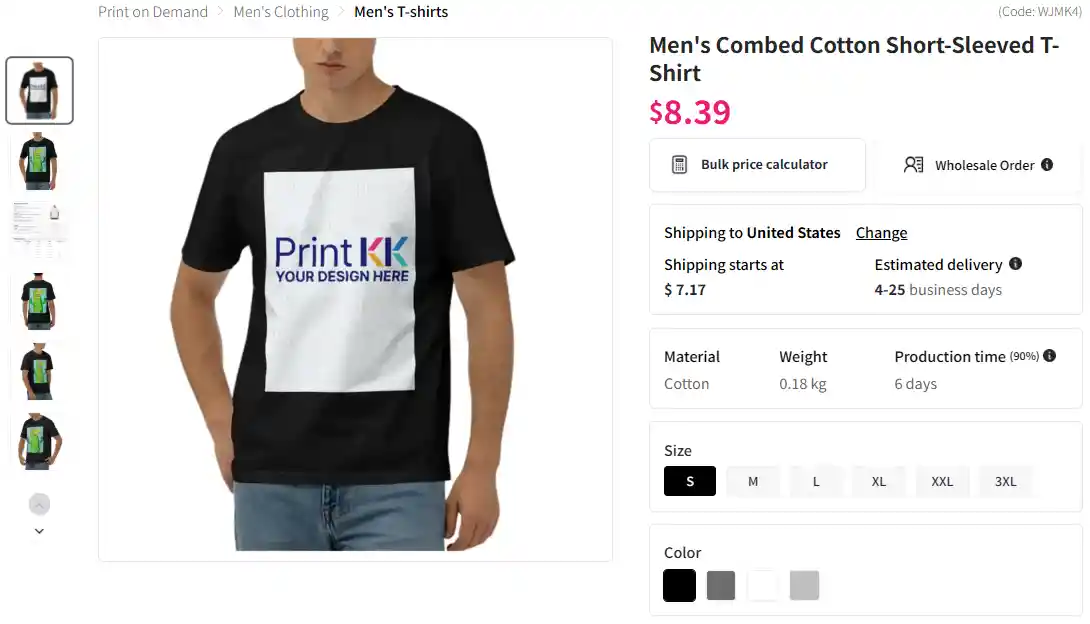
When you start with a PrintKK Men's Combed Cotton T-Shirt, the base price is $8.39. This is the amount you pay to the POD provider for a blank shirt and printing.
Knowing this cost is the first step in calculating your selling price.
Keep in mind that this is just the product—shipping, platform fees, and advertising are extra and need to be added separately to know your true cost.
2. Calculating Shipping Costs
Shipping varies depending on the country. For example, sending a shirt to the United States costs $7.17, but shipping to Australia is $6.34.
If you plan to sell internationally, you need to factor in these differences so that your profit margin remains consistent. Ignoring shipping can make a product that seems cheap suddenly unprofitable.
3. Adding Platform and Transaction Fees
Different selling platforms take their share from each sale. Shopify, Etsy, and other carts all charge transaction fees, and sometimes payment processors add more. To keep your pricing realistic, add:
- Platform transaction fees
- Payment processing fees
- Any listing fees
This ensures that the money you see is closer to the money you actually keep.
4. Deciding on Your Profit Margin
After calculating base costs, shipping, and fees, you can add your profit. A reasonable starting point is 20–40% above your total cost.
For example, if your shirt costs $8.39, shipping $7.17, and fees $2, your total cost is $17.56.
Adding a 30% margin makes your selling price about $22.83. This keeps your pricing fair while giving you a reasonable profit.
5. Considering Optional Advertising Costs
If you plan to run ads, include them in your pricing as well. Even a small campaign can affect your margin significantly.
For instance, if advertising adds $5 per sale, your $22.83 shirt effectively costs $22.83 + $5 = $27.83 before profit.
Factoring this in helps avoid surprises and ensures your marketing doesn't eat into your earnings.
Expert Tips
Learning how to price print on demand products is key to running a profitable POD business.
Compare your prices with competitors. Adjust based on results and customer feedback. Remember that repeat customers increase long-term profit. Keep track of every sale and cost.
By being mindful and strategic, you can set prices that cover expenses and still make money. Focus on consistency and value.
Over time, your pricing decisions will become easier and more effective, helping your business grow steadily.
FAQs
What's the best pricing strategy for print on demand?
The best approach balances your costs, platform fees, and customer expectations. Price competitively while keeping room for profit. Adjust for demand, product uniqueness, and seasonal trends to stay flexible and profitable.
What is a good profit margin for print on demand?
A healthy margin usually ranges from 30% to 50%. This ensures you cover production, shipping, and marketing while still earning a decent return for your time and creativity.
Is print-on-demand still profitable in 2026?
Yes, POD remains viable if you choose the right niche and manage costs carefully. Success depends on creativity, smart pricing, and understanding customer preferences in a competitive market.
Is it cheaper to sell on Etsy or Shopify?
Etsy has lower upfront costs but higher per-sale fees. Shopify has subscription fees but gives more control. Your choice depends on volume, product pricing, and how much marketing you plan to do.


 Global Shipping


 Made in USA
 Free shipping